
Private Label vs Custom Perfume: Which Fragrance Model Fits Your Malaysian Brand?
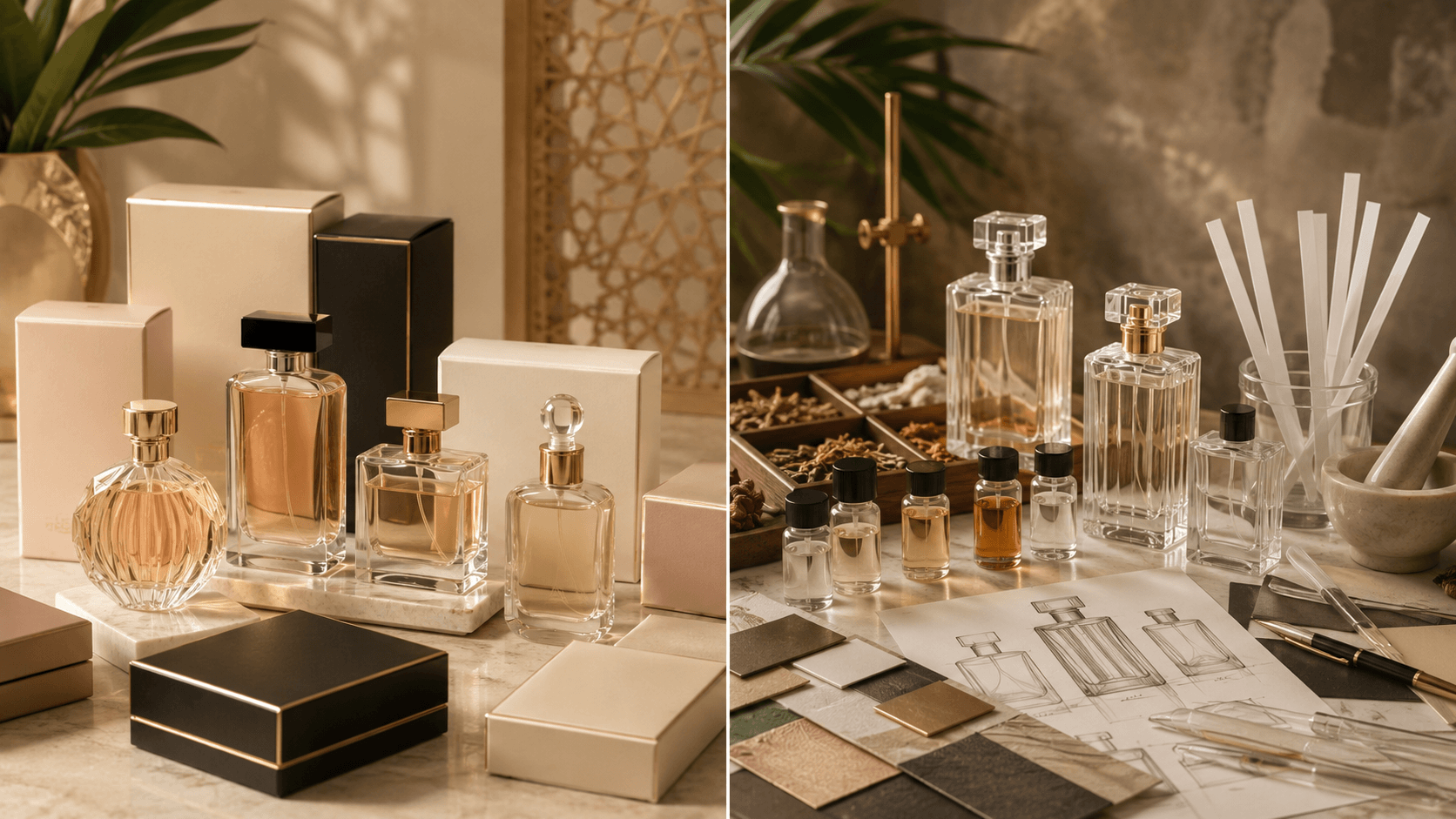
OEM Perfume Malaysia: Private Label or Custom Scent?
Should you launch your fragrance brand with a ready-made scent, or invest in developing a fully custom perfume from scratch?
This is one of the most important decisions for any business entering Malaysia’s fast-growing fragrance market — whether you’re a retailer, a spa brand, or an entrepreneur building a signature label.
Choosing between private label perfume and custom perfume manufacturing will shape your timeline, your budget, your Halal and regulatory pathway, and how differentiated your brand feels on the shelf.
Both models have a place. Private label gets a product to market fast with proven, pre-developed scents. Custom development — the core of true OEM perfume Malaysia services — builds an original fragrance identity from the ground up. Understanding how each works, and when to use them, will help you make the right call for your brand.
What Is Private Label Perfume?
Private label perfume refers to fragrances that are already formulated and produced by a manufacturer, which brands can then customise with their own branding, bottle, and packaging. The scent itself already exists — you select from a range of proven fragrance profiles and apply your brand identity on top.
Key Characteristics of Private Label Perfume:
- Ready-made, pre-tested fragrance formulas
- Faster production and launch timelines
- Lower development costs
- Minimal R&D or perfumer involvement required
- Customisable bottles, caps, and packaging
For many new fragrance brands in Malaysia, private label is the fastest realistic path to market. An experienced OEM perfume Malaysia partner will typically offer a curated library of tested scent profiles — floral, woody, citrus, oud-based — that can be quickly matched to a brand and packaged for launch.
What Is Custom Perfume Development?
Custom perfume development means creating a fragrance from scratch, built specifically around a brand’s identity, target market, or signature concept. This is the process most people mean when they refer to custom perfume Malaysia services.
This typically involves:
- Scent direction and concept briefing
- Selection of raw materials, aroma chemicals, and fragrance oils
- Structuring the top, heart (middle), and base notes
- Sampling, refinement, and stability testing
- Regulatory documentation and compliance checks
Key Features of Custom Perfume Development:
- Fully original and exclusive fragrance formula
- Greater control over ingredients, concentration, and longevity
- Stronger differentiation and brand storytelling
- Higher development cost and longer timeline
- Requires closer collaboration with a perfumer or formulation team
This model suits brands that want a genuine signature scent — one that functions almost like an invisible logo for the brand — rather than a fragrance shared across multiple labels.
Key Differences Between Private Label and Custom Perfume
Aspect | Private Label Perfume | Custom Perfume (OEM Development) |
Formula ownership | Pre-made, often shared across brands | Exclusive, developed for your brand only |
Customisation | Mostly limited to bottle, packaging, and branding | Full control over scent structure, concentration, and ingredients |
Time to market | Weeks | Typically 2–4 months, depending on complexity |
Investment | Lower upfront cost | Higher upfront cost due to R&D and testing |
Minimum order quantities (MOQ) | Generally lower | Often higher, though negotiable with the right partner |
Brand differentiation | Moderate — packaging differentiates, scent may not | High — the fragrance itself is unique |
Best suited for | Startups, market testing, fast launches | Established or premium brands seeking a signature identity |
1. Time to Market
Private label perfume offers a clear speed advantage. Because the formulation already exists and has been tested, brands can move from selection to packaged product in a matter of weeks. Custom perfume development requires scent briefing, sampling rounds, and stability testing, which realistically takes longer — though a responsive OEM partner can still keep this efficient.
2. Cost and Investment
Private label is more cost-efficient at the outset since there’s no formulation R&D to fund. Custom perfume development requires investment in raw material sourcing, perfumer time, and sampling iterations — but this investment builds a formula your brand actually owns.
3. Product Uniqueness
Private label fragrances may be used across multiple brands, even if your bottle and branding are unique. Custom perfume development produces a scent that’s genuinely exclusive to your label — a meaningful advantage for brands trying to stand out in Malaysia’s increasingly crowded fragrance and gifting market.
4. Flexibility and Control
With private label, brands typically can’t alter the core formula — customisation happens at the packaging and branding layer. Custom development gives full control over concentration, longevity, and the specific notes used, which matters if you’re targeting a particular market segment or price point.
Malaysia-Specific Considerations
Fragrance brands operating in Malaysia face a few considerations that don’t come up in every market:
Halal certification. Given Malaysia’s Muslim-majority consumer base, Halal status (JAKIM certification) is a significant differentiator for fragrance products — particularly for alcohol-free or attar-style formats, which are popular among consumers seeking Halal-compliant options. This applies to both private label and custom development, but custom formulation gives brands more control over exactly which base (alcohol-based or oil/attar-based) and ingredients go into the final product.
Regulatory notification. Cosmetic and fragrance products sold in Malaysia need to be notified with the National Pharmaceutical Regulatory Agency (NPRA) before sale. Whichever model you choose, your manufacturing partner should handle this notification process as part of a genuine one-stop service — not leave it for the brand to navigate alone.
Format preferences. The Malaysian market shows strong demand across both Western-style eau de parfum/eau de toilette concentrations and Middle Eastern-influenced oil-based attars. Custom development is particularly useful here, since it allows a brand to build a fragrance specifically suited to the format its target customers prefer, rather than adapting an existing Western-market formula.
When to Choose Private Label Perfume
Private label is particularly suited to brands that prioritise speed, lower risk, and cost efficiency.
Ideal Scenarios:
- New fragrance brands entering the market for the first time
- Businesses testing demand before committing to a signature scent
- Retailers or spas expanding into a fragrance product line
- Entrepreneurs working with limited startup capital
Private label lets a brand validate demand and start generating revenue before investing in a fully custom formula.
When to Choose Custom Perfume Development
Custom perfume development suits brands with a clear identity and a longer-term growth plan.
Ideal Scenarios:
- Established brands seeking a genuine signature scent
- Premium or niche positioning where exclusivity matters
- Brands targeting a specific format (e.g., Halal-certified attar) not well served by off-the-shelf options
- Businesses with the budget to invest in R&D and sampling
This approach supports stronger brand identity, better long-term differentiation, and — because the formula is exclusive — reduces the risk of a competitor launching an identical scent.
A Hybrid Strategy: The Best of Both Worlds
Many successful fragrance brands don’t pick one model exclusively. A common approach is to:
- Launch with private label fragrances to enter the market quickly and build early revenue
- Gradually introduce custom-developed scents for hero products or premium collections
- Use market response from the private label phase to inform the brief for custom development
This staged approach balances speed, cost, and long-term differentiation — letting a brand test the market before committing to the higher investment of full custom development.
The Role of an OEM Perfume Manufacturer
Whichever path you choose, working with an experienced OEM perfume Malaysia partner matters. A capable manufacturer should support:
- Formula selection (private label) or custom scent development
- Halal and NPRA regulatory compliance
- Bottle, cap, and packaging design
- Quality control and stability testing
- Low MOQ options for brands testing new product lines
A good OEM partner can also advise on ingredient trends, format preferences in the Malaysian market, and cost optimisation across both models — which matters whether you’re launching your first fragrance or scaling an existing line.
Common Mistakes to Avoid
A frequent misstep is choosing purely on cost. Private label may look more affordable initially, but if long-term differentiation matters to the brand, an identical scent sold under multiple labels can undercut that positioning. Conversely, committing to a fully custom fragrance before validating market demand can tie up capital in a formula that hasn’t been tested against real customer response.
Another common issue is underestimating branding. Even with a private label scent, strong packaging, positioning, and storytelling are what actually differentiate the product on the shelf.
Conclusion: Which Option Is Better for Your Brand?
There’s no single right answer. The choice between private label perfume and custom perfume Malaysia development depends on your brand’s budget, timeline, and long-term positioning.
- Choose private label perfume for speed, lower cost, and market testing
- Choose custom perfume (OEM) development for exclusivity, control, and long-term brand identity
For many fragrance brands, the smartest strategy isn’t choosing one permanently — it’s knowing when to use each as the brand grows. If you’re weighing similar questions for a broader product line, our comparison of private label versus custom formulation for skincare covers the same decision framework applied to skincare and personal care.
Ready to Build Your Fragrance Brand?
Whether you’re exploring private label perfume for a fast launch or planning a fully custom perfume Malaysia development for long-term differentiation, partnering with an experienced, Halal-certified OEM manufacturer makes the process smoother from concept to shelf. Browse our full range of fragrance and perfume products, or explore our OEM and private label services to see how we can support your brand.


