
How to Build a Profitable Perfume Brand in 2026
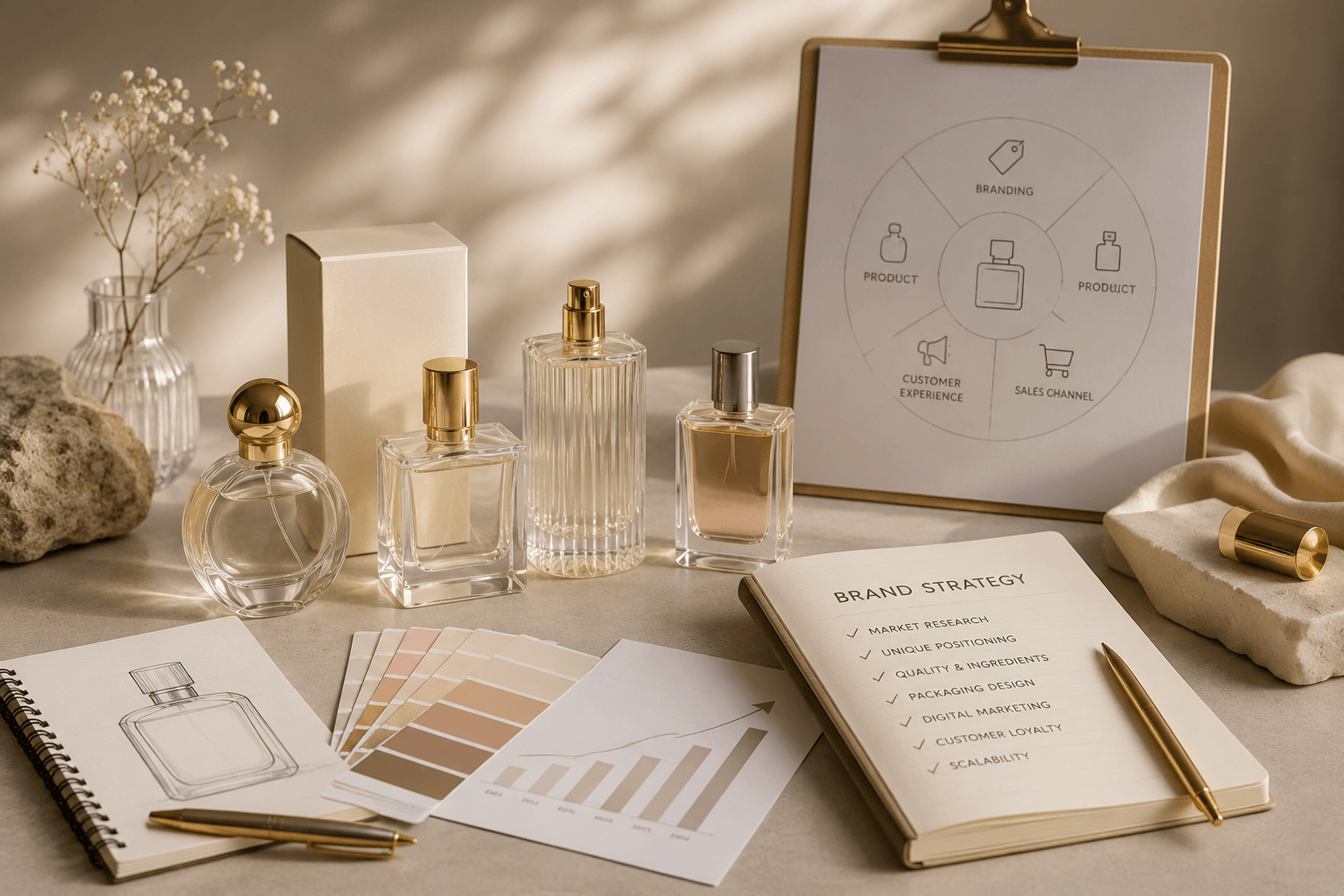
How to Build a Profitable Perfume Brand in 2026
Launching a perfume brand today is more accessible than ever — but “accessible” and “profitable” aren’t the same thing. The fragrance market keeps growing, more entrepreneurs are entering it every year, and consumers are more informed than ever about what they’re buying.
Building a brand that actually turns a profit requires getting several decisions right at once: your identity, your manufacturing model, your compliance, your pricing, and your marketing. Here’s a practical roadmap for building a profitable fragrance brand, working with a perfume manufacturer Malaysia partner from day one.
Key Takeaways
- Profitability starts with clarity: know your niche, your target customer, and what emotional positioning your perfume brand stands for before touching formulation.
- Choosing between private label and OEM perfume development shapes your cost structure, timeline, and long-term differentiation — get this decision right early.
- Minimum order quantities (MOQ), packaging costs, and compliance (Halal, NPRA, IFRA) all directly affect your margins, so factor them into pricing from the start, not after launch.
- Packaging and brand storytelling matter as much as the scent itself in a crowded market — buyers assess quality visually before they ever smell the product.
- Digital marketing — SEO, short-form video, micro-influencer partnerships — is now the primary driver of discovery for new fragrance brands.
- Sustainable profitability comes from repeat buyers, not one viral moment — plan for retention, not just launch traffic.
Step 1: Define Your Niche and Brand Identity
Before approaching any manufacturer, get clear on why your perfume brand needs to exist. What does it stand for? Who is it for? What occasion, mood, or identity does it serve? Among the many perfume brands competing for shelf space and social feeds today, the ones that succeed are rarely the ones with the loudest launch — they’re the ones with the clearest positioning.
Practical questions to answer at this stage:
- Is your brand luxury, niche, everyday, or gifting-focused?
- Who is your target customer, and what do they already buy?
- What emotional territory does your scent occupy — fresh and daytime, rich and evening, unisex and versatile?
- What price point are you realistically targeting, and does your positioning support it?
This clarity feeds directly into your formulation brief, your packaging direction, and your marketing story later on — so it’s worth spending real time here before moving to manufacturing decisions.
Step 2: Choose Your Manufacturing Model
The next major decision is whether to build your line through private label (selecting from proven, pre-developed formulas) or through custom OEM perfume development (building a fragrance from scratch for your brand alone).
Private label gets you to market faster and at lower upfront cost — ideal for testing demand or launching with limited capital. Custom OEM development takes longer and costs more, but gives you a genuinely exclusive formula, which matters if long-term brand equity and differentiation are your goal.
Many successful brands start with private label to validate the market, then invest in custom development for hero products once demand is proven. If you’re weighing this decision in more depth, our full comparison of private label versus custom formulation walks through the trade-offs in detail.
Step 3: Understand MOQ and Startup Investment
Minimum order quantities are one of the biggest practical barriers new fragrance founders run into. Large-scale facilities are often built for volume — thousands of units per run — which can price out a first-time brand before it even launches. Look specifically for a perfume manufacturer Malaysia partner offering low MOQ options designed for startups, so you can launch with a manageable initial investment and scale production as demand grows, rather than over-committing capital upfront.
Budget realistically for:
- Formulation or private label selection costs
- Bottle, cap, and packaging tooling
- Minimum order production run
- Regulatory notification and testing
- Initial marketing and sampling
Treating your first production run as a market validation step — not a make-or-break bet — protects your cash flow and gives you room to adjust before scaling.
Step 4: Get Compliance Right from Day One
Regulatory compliance isn’t just paperwork — it’s what allows your product to legally reach shelves, and getting it wrong after launch is far more expensive than building it in from the start.
Halal certification (JAKIM). Given Malaysia’s Muslim-majority consumer base, Halal status is a genuine commercial advantage, particularly for alcohol-free or attar-style formats. If Halal positioning matters to your brand, this needs to shape your formulation approach from the very first brief — not be retrofitted later.
NPRA notification. Cosmetic and fragrance products sold in Malaysia must be notified with the National Pharmaceutical Regulatory Agency before sale. A capable OEM partner should handle this as part of a genuine one-stop service.
IFRA compliance. All fragrance formulations need to stay within limits set by the International Fragrance Association, covering maximum usage levels for specific ingredients by category. This affects everything from allergen labelling to how concentrated your final formula can be.
Building these into your development process from day one — rather than treating them as a final checkbox — keeps your launch timeline predictable and avoids costly reformulation down the line.
Step 5: Invest in Packaging and Brand Experience
In a market where most fragrance discovery now happens online, packaging does a huge amount of the selling before a customer ever smells the product. The weight of the bottle, the finish of the cap, the quality of the box — these details signal whether a brand feels premium or ordinary, often before a single review is read.
Practical priorities:
- Choose bottle and cap designs that match your brand positioning — minimalist for clean, modern brands; ornate or weighted glass for luxury positioning
- Keep branding consistent across bottle, box, and any secondary packaging
- Test physical samples before committing to full production, checking colour accuracy, embossing, and finish quality
- Don’t neglect the unboxing experience — it’s now part of the marketing content customers create and share themselves
Packaging spend should scale with your positioning: a mass-market product doesn’t need the same packaging investment as a premium niche launch, but under-investing at any price point undermines perceived value.
Step 6: Price for Profitability
Profitability starts with an honest cost breakdown, not a guess at what feels “premium enough.” Your cost structure typically includes:
Cost Component | Notes |
Fragrance oil / concentrate | Often the single largest raw material cost; scales with concentration |
Bottle, cap, and packaging | Varies significantly by material and finish |
Production and filling | Per-unit cost, generally lower at higher volumes |
Regulatory notification and testing | One-time or per-formula cost |
Marketing and sampling | Ongoing cost, especially at launch |
A common mistake is pricing based on what competitors charge rather than working up from actual landed cost plus a sustainable margin. Build your retail price from your true cost base first, then check it against market positioning — not the other way around.
Step 7: Build Your Marketing and Digital Presence
Modern perfume buyers research extensively before purchasing — comparing notes, packaging, and brand values across multiple sources before committing. This means your digital presence isn’t optional; it’s the primary channel through which most new customers will discover your brand.
Short-form video. Unboxing videos, bottle close-ups, spray reactions, and day-versus-night comparisons consistently outperform traditional product photography for fragrance content on Instagram and TikTok.
Content marketing and SEO. Blog content answering real buyer questions — concentration differences, longevity tips, seasonal recommendations — builds organic search visibility over time and should link naturally back to your product pages.
Micro-influencer partnerships. Creators with smaller but genuinely engaged followings (roughly 10,000–100,000) tend to outperform larger influencers for fragrance specifically, since audiences trust their scent opinions as more authentic.
Email and retention marketing. New launches, seasonal recommendations, and scent-story content keep your brand present between purchases — critical for a category where repeat buying, not one-time discovery, drives long-term profitability.
Step 8: Plan for Scale
Launching small and validating demand is smart. But profitability compounds when you have a clear plan for what happens after a successful first run: which SKUs to expand, whether to move from private label to custom development for your best-performing scent, and how your packaging and pricing hold up as volume increases. Building this thinking into your original manufacturing partnership — rather than starting from scratch each time you scale — saves both time and cost as your brand grows.
Common Mistakes That Kill Profitability
Underestimating true landed cost.
Fragrance oil, packaging, and compliance costs add up quickly; brands that price before calculating full cost often discover their margins are thinner than expected.
Copying a competitor’s concentration or positioning blindly.
What works for one brand’s cost structure and audience may not translate directly to yours.
Treating compliance as an afterthought.
Retrofitting Halal certification or IFRA compliance after formulation is far more expensive than building it in from the brief stage.
Under-investing in packaging relative to positioning.
A premium price point paired with generic packaging undermines trust before the product is even opened.
Chasing a single viral moment instead of building retention.
Sustainable perfume brand profitability comes from repeat buyers and consistent marketing effort, not one successful launch campaign.
Building a Brand That Lasts
A profitable perfume brand in 2026 isn’t built on a single good idea — it’s built on getting a sequence of decisions right: clear positioning, the right manufacturing model, realistic MOQ and cost planning, compliance built in from the start, packaging that matches your price point, and a genuine digital marketing strategy. Get these right together, and a well-positioned fragrance brand can be genuinely profitable well beyond its first production run.
If you’re planning your first fragrance launch or scaling an existing line, browse our fragrance products, or explore our OEM and private label services to see how a Halal-certified, GMP-compliant Malaysian manufacturing partner can support your brand from formulation through to launch.


